
SpaceX Is Public: What Everyday Investors Need to Know
After years of speculation, anticipation, and investor wish lists, SpaceX has officially gone public under the ticker SPCX; and Elon Musk if the world’s first trillionaire.
For many investors, this is one of the most exciting stock market events of the decade. Founded in 2002 SpaceX has spent more than two decades transforming the aerospace industry while remaining a private company. During that time, access to SpaceX shares was largely limited to venture capital firms, institutional investors, and wealthy individuals.
For investors who have followed the company for years, this represents a historic moment. The company entered the public markets with significant investor interest and quickly became one of the most talked-about stocks of the year.
The IPO also highlights a broader trend: investors are increasingly looking for opportunities in industries that could shape the future, including artificial intelligence, space exploration, advanced communications, and infrastructure.
Now, everyday investors can buy shares of one of the world's most recognizable and ambitious companies.

Image courtesy of Unsplash
But before you rush to your brokerage account, it's worth taking a closer look at what SpaceX does, why investors are excited, and what you should consider before adding the stock to your portfolio.
What Is SpaceX?
Most people know SpaceX for its rocket launches, but the company has evolved into much more than an aerospace business.
Today, SpaceX operates across several rapidly growing industries, including:
Commercial rocket launches
Government and defense contracts
Human spaceflight missions
Satellite deployment
Starlink satellite internet services
Artificial intelligence and advanced technology initiatives
The company has become a dominant force in the global space industry by developing reusable rockets that significantly reduce the cost of sending people and equipment into space.
Its ability to innovate has attracted customers ranging from private companies to government agencies, helping SpaceX build a business that extends far beyond rocket launches.
Why Is Everyone Talking About the IPO?
Simply put, opportunities like this are rare. Most high-growth companies go public much earlier in their lifecycle. SpaceX chose to remain private for years while continuing to expand its operations and increase its valuation.
As a result, public investors have been watching from the sidelines while the company grew into one of the most valuable private businesses in the world.
The IPO represents the first opportunity for many investors to directly participate in the company's future growth. Adding to the excitement is the fact that SpaceX is often viewed as more than a single business. Many investors see it as a unique combination of aerospace, telecommunications, infrastructure, defense, and technology. That broad exposure is one reason why demand for the stock has been so strong.
The Real Growth Engine: Starlink
While rockets may generate headlines, Starlink is arguably the company's most important business segment.
Starlink provides satellite internet service to customers around the world, particularly in rural and underserved communities where traditional internet infrastructure may be limited.
Unlike rocket launches, which can vary from year to year, internet subscriptions generate recurring revenue. This creates a more predictable stream of income for the company and may help reduce reliance on launch contracts alone.
Many analysts believe Starlink could eventually become one of the most valuable parts of the SpaceX business.
For investors, recurring revenue businesses are often attractive because they can provide more consistent cash flow and long-term growth potential.
What to Consider Before Buying SPCX Shares
While the excitement surrounding the IPO is understandable, investing should always start with research, not headlines.
Here are a few things to keep in mind before buying shares.
1. Understand the Business
Many people are attracted to the stock because of Elon Musk or the company's ambitious vision for space exploration.
While those factors may be exciting, investors should understand how the company actually generates revenue and where future growth is expected to come from.
The better you understand the business, the better equipped you'll be to evaluate whether the stock belongs in your portfolio.
2. Expect Volatility
Newly public companies often experience significant price swings during their first weeks and months of trading.
Investor excitement, media coverage, and changing expectations can cause the share price to move sharply in either direction.
If you're investing in SpaceX, be prepared for volatility and avoid making emotional decisions based on short-term market movements.
3. Think About Diversification
No matter how promising a company may appear, putting all of your money into a single stock can increase risk.
SpaceX may be an exciting investment opportunity, but it should be considered within the context of your overall financial plan.
Diversification remains one of the most effective ways to manage risk and build long-term wealth.
4. Consider Investing Gradually
If you're interested in owning shares but are concerned about short-term price fluctuations, consider investing gradually over time.
This strategy, often referred to as dollar-cost averaging, allows investors to spread their purchases across multiple dates rather than trying to perfectly time the market.
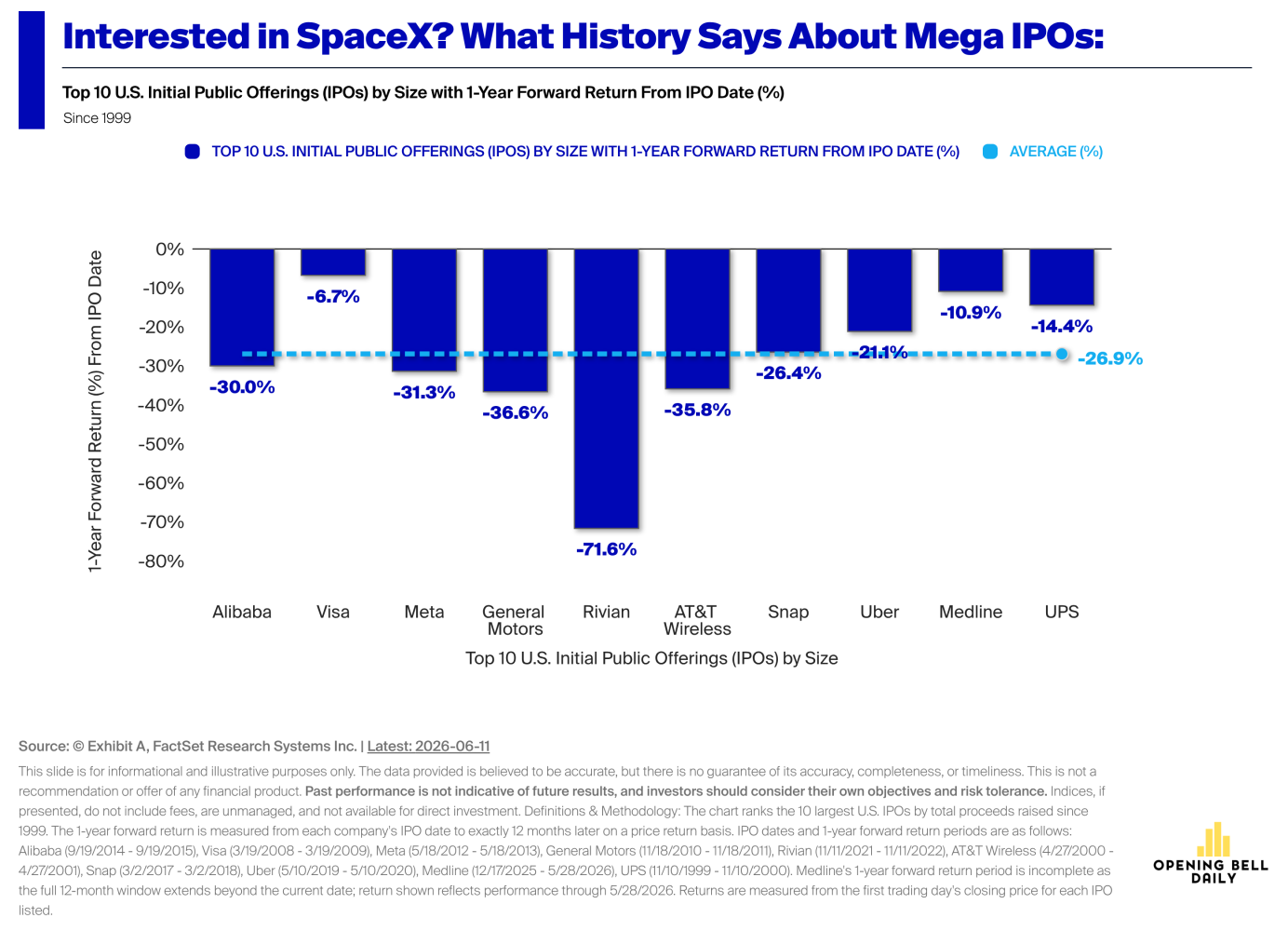
Image source (C): Opening Bell Daily FactSet Research Systems - June 11 2026
The Bottom Line
The SpaceX IPO marks a significant milestone for both the company and investors.
For the first time, everyday investors have the opportunity to own a piece of a company that has transformed the aerospace industry and expanded into communications, technology, and artificial intelligence.
But as exciting as this moment may be, successful investing isn't about chasing the hottest stock in the headlines.
It's about understanding what you're buying, assessing the risks, and making decisions that align with your long-term financial goals.
SpaceX may prove to be one of the defining companies of the next generation. Whether or not it deserves a place in your portfolio will depend on your investment strategy, risk tolerance, and financial objectives.
One final reminder: FOMO is not an investment strategy. Before you click "buy," make sure you're investing because you've done your homework, spoke with your financial planner, not because everyone else is talking about it.