
When Canadians think about registered savings plans, accounts like the TFSA, RRSP, and RESP typically come to mind. Yet there is another registered plan that offers significant long-term benefits and remains largely overlooked: the Registered Disability Savings Plan (RDSP).
The RDSP is designed to help Canadians living with disabilities build long-term financial security. Through tax-deferred investment growth, along with generous government grants and bonds, the plan can provide a meaningful financial advantage for eligible individuals and their families.

Despite these benefits, many Canadians who qualify are either unaware of the RDSP or do not fully understand how it works. As a result, they may miss out on thousands of dollars in government assistance over their lifetime.
Financial literacy is about more than budgeting and investing. It is also about understanding the programs and opportunities available to help build long-term financial security. If you or someone you know may qualify, learning about the RDSP is well worth your time.
What is an RDSP?
A Registered Disability Savings Plan is a long-term savings account designed to help Canadians living with disabilities save for the future. Like an RRSP or TFSA, the money inside the account can be invested and grows tax-deferred over time. The real difference is that the government may also contribute money through grants and bonds, helping your savings grow even faster.
Think of it as the government helping you build your nest egg.
Who is eligible?
To open an RDSP, an individual must:
Be eligible for the Disability Tax Credit (DTC)
Have a valid Social Insurance Number (SIN)
Be a resident of Canada when the plan is opened and when contributions are made
Open the plan before December 31 of the year they turn 59
One important thing to remember is that qualifying for the Disability Tax Credit is the first step. If you have not applied for the DTC, you will need to do that before opening an RDSP.
The Disability Tax Credit: The First Step to Opening an RDSP
Before you can open a Registered Disability Savings Plan, you must first qualify for the Disability Tax Credit (DTC).
The DTC is a non-refundable tax credit that helps reduce the amount of income tax a person with a disability, or their supporting family member, may have to pay. More importantly, it unlocks access to several valuable government programs, including the RDSP.
To qualify, a medical practitioner must certify that you have a severe and prolonged impairment in physical or mental functions. The Canada Revenue Agency (CRA) then reviews your application to determine your eligibility.
Some conditions that may qualify include:
Mobility impairments
Vision or hearing loss
Developmental disabilities
Autism spectrum disorder
Multiple sclerosis
Parkinson's disease
Severe mental health conditions
Other prolonged impairments that significantly affect daily living
It is important to note that having a medical diagnosis does not automatically qualify someone for the DTC. The CRA assesses how the condition affects day-to-day functioning.
If you are unsure whether you or a family member may qualify, speak with your healthcare provider or review the eligibility criteria on the Canada Revenue Agency website.
Who can contribute?
One of the best features of an RDSP is that contributions are not limited to the beneficiary.
Parents, grandparents, siblings, relatives, and even friends can contribute, provided they have the permission of the plan holder. This makes the RDSP a wonderful way for families to work together toward someone's future financial security.
While there is no annual contribution limit, lifetime contributions are capped at $200,000.
How does the money grow?
Just like other registered investment accounts, the money inside an RDSP can be invested. Be sure to connect with your bank, or financial planner/advisor to get their advice and depending on the financial institution, you may be able to invest in options such as:
Mutual funds
Guaranteed Investment Certificates (GICs)
Savings deposits
Professionally managed investment portfolios
Over time, your investments can grow through interest, dividends, and market returns, all while benefiting from tax-deferred growth. Taxes generally are not paid until money is withdrawn, and only certain portions of the withdrawal are taxable.
Understanding the Government Contributions
One of the most valuable features of an RDSP is the opportunity to receive financial assistance from the Government of Canada through two programs: the Canada Disability Savings Grant (CDSG) and the Canada Disability Savings Bond (CDSB).
Together, these incentives can add tens of thousands of dollars to an RDSP over a beneficiary's lifetime, making them one of the most generous savings incentives available in Canada.
Canada Disability Savings Grant (CDSG)
The Canada Disability Savings Grant matches personal contributions made to an RDSP. The matching rate depends on family income and the amount contributed.
Eligible beneficiaries may receive up to $3,500 in grants each year until December 31 of the year they turn 49, to a lifetime maximum of $70,000.
Government grants may be paid until December 31 of the year the beneficiary turns 49.
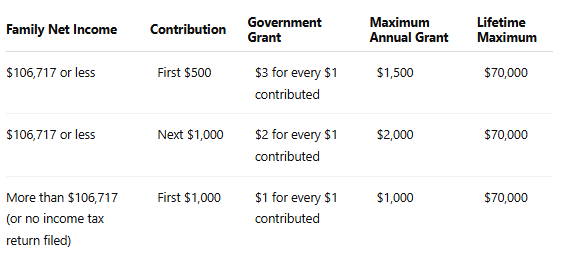
The Canada Disability Savings Grant matches personal contributions made to an RDSP. The matching rate depends on family income and the amount contributed.
Source: RBC
Canada Disability Savings Bond (CDSB)
The Canada Disability Savings Bond is intended for lower-income Canadians and, unlike the grant, does not require any personal contributions.
Eligible beneficiaries may receive up to $1,000 annually, to a lifetime maximum of $20,000. Bond payments may be made until December 31 of the year the beneficiary turns 49.
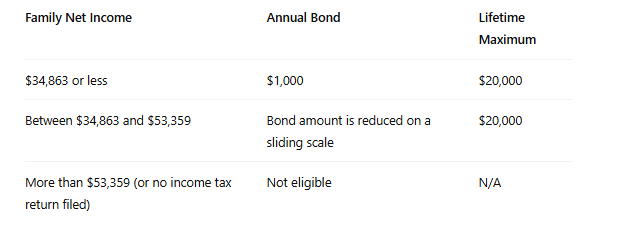
The Canada Disability Savings Bond is available to lower-income Canadians and, unlike The Canada Disability Savings Grant, does not require any personal contributions.
Source: RBC
The Bottom Line
The Registered Disability Savings Plan is one of Canada's most valuable long-term savings programs for eligible individuals living with disabilities. By combining tax-deferred investment growth with government grants and bonds, the RDSP offers an opportunity to build meaningful financial security over time.
For eligible Canadians and their families, understanding how the RDSP works is the first step toward making the most of one of Canada's most generous savings programs. Remember, speak with your medical doctor for the DTC, then speak with you bank or financial planner for more information on any and all investments.